

Most conversations about information security focus on two moments:
- When documents are created
- When they’re finally destroyed
Policies are written. Rules are defined. Shredding days are scheduled.
But in between those two points sits something far less organised — and far more risky.
It’s the forgotten middle.
And it’s where most information security issues quietly begin.
The Part of the Document Lifecycle Nobody Talks About
On paper, document management looks neat and linear.
| Stage | What businesses usually plan for |
|---|---|
| Creation | Templates, systems, access permissions |
| Active use | Filing systems, shared drives |
| In-between | Rarely defined |
| Destruction | Shredding, purge days, compliance |
The problem isn’t how documents are created or destroyed.
It’s everything that happens after a document stops being useful — but before anyone decides what to do with it.
That’s the middle.
What the “Middle” Looks Like in Real Offices
This stage rarely feels risky. In fact, it usually feels harmless. 
Common examples we see:
- Boxes stored under desks “for now”
- Filing cabinets no one has opened in years
- Old HR or client files kept “just in case”
- Scanned documents, with paper originals still retained
- Shared responsibility for records — which often means no responsibility
None of this triggers alarm bells.
Until something changes.
When Risk Feels Ordinary
One of the reasons the middle is so easy to overlook is that it feels familiar. Documents don’t suddenly become sensitive when they stop being useful. They just sit there. Over time, familiarity dulls awareness, and what once felt temporary becomes permanent simply because it’s always been there.
Risk doesn’t announce itself. It blends in.
Why Annual Shredding Feels Responsible (But Has Limits)
Many businesses rely on annual or occasional shredding days, and that’s not a bad thing. Clean-outs feel productive. They clear space. They provide a sense of control.
The limitation is that they’re reactive.
Annual shredding:
- Deals with visible backlog
- Relies on memory and judgement
- Allows risk to build quietly between clean-outs
Shredding itself isn’t the weak point. What happens before shredding is.
Where Problems Usually Surface
Information security issues rarely appear during routine operations. They tend to surface during moments of change.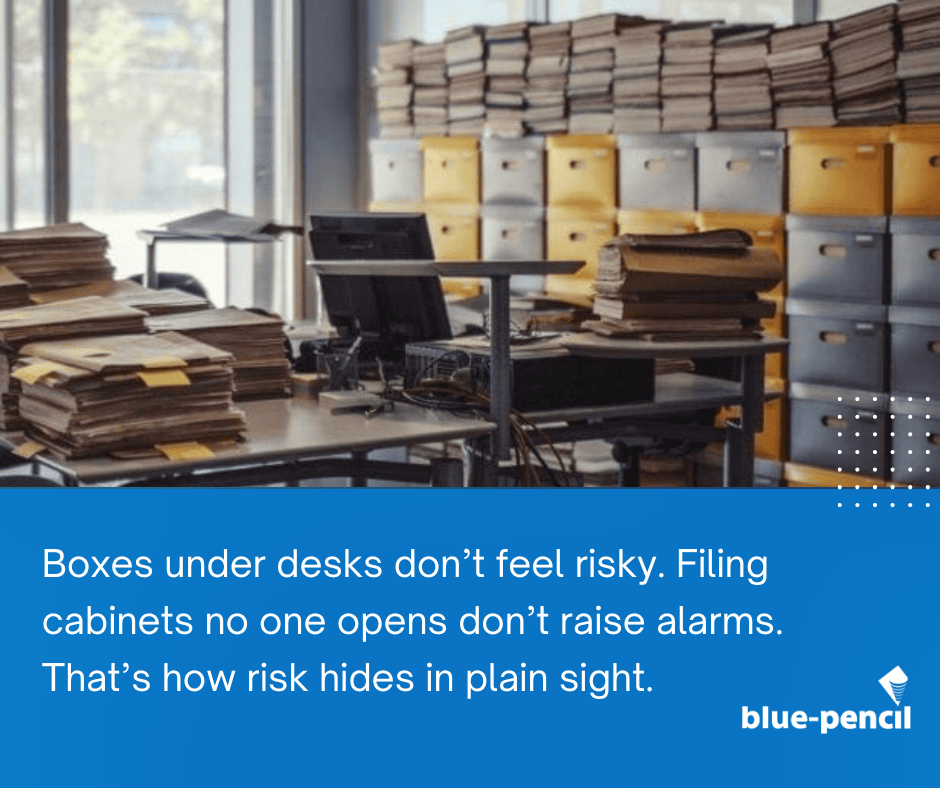
Common triggers include:
- Office moves or renovations
- Staff turnover
- Business growth
- Audits or legal requests
Suddenly, long-ignored questions become urgent:
Where is that file?
Why do we still have this?
Who was responsible for managing these records?
The forgotten middle is usually exposed under pressure.
A Quick Reality Check: Routine vs Change
| Situation | Risk visibility |
|---|---|
| Day-to-day operations | Low |
| Staff changes | Moderate |
| Office moves | High |
| Legal or audit requests | Very high |
The risk was always there. Change just forces it into view.
Why Good Businesses Still End Up Here
Most businesses don’t set out to manage records poorly. They inherit systems, habits, and decisions made years earlier. As teams grow and technology changes, document handling rarely gets redesigned from scratch. Small, sensible decisions accumulate into a system no one consciously planned — but everyone depends on.
This is operational drift, not failure.
What a Healthier Middle Actually Looks Like
A safer middle doesn’t require complex rules or heavy compliance programs. It usually comes down to reducing ambiguity.
Healthier practices tend to include:
- Secure containers instead of open boxes
- Clear guidance on what should be kept or destroyed
- Fewer individual judgement calls
- Predictable, regular disposal
The goal isn’t perfection.
It’s consistency.
The Cost of Uncertainty (Not the Cost of Non-Compliance)
The biggest cost of unmanaged records is rarely fines or breaches. It’s uncertainty. People hesitate to destroy documents because they’re unsure. Files are kept longer than needed because no one wants to make the wrong decision. Time is lost searching for records that should have been disposed of years earlier.
Uncertainty encourages over-retention — and over-retention quietly increases risk.
Why This Is Rarely Fixed All at Once
Records management improvements rarely happen in a single project. Most organisations make progress gradually, often prompted by change. The businesses that manage risk best aren’t the ones with the most detailed policies. They’re the ones that steadily remove guesswork, one decision at a time.
Simple systems, applied consistently, outperform big clean-ups.
A Simple Self-Check (No Audit Required)
Ask yourself:
- Do we know what documents we’re keeping?
- Do we know why we’re keeping them?
- Do we know when they’ll be destroyed?
- Do we control who can access them?
If those answers aren’t clear, the issue likely isn’t shredding itself. It’s sitting quietly in the middle.
Final Thought
Shredding matters.
Secure storage matters.
Compliance matters.
But most information security issues don’t come from dramatic failures. They come from everyday habits that were never designed — just inherited.
Paying attention to the forgotten middle doesn’t mean changing everything overnight. It simply means making the part that matters most visible, manageable, and consistent.