
When it comes to protecting sensitive information, compliance doesn’t end when a document’s no longer needed — it ends when that document is destroyed securely.
In 2026, data privacy expectations are higher than ever, and Canadian businesses face stricter oversight when it comes to how they handle, store, and dispose of personal information. Whether you manage client files, employee records, or financial data, understanding your legal obligations for document destruction is critical to staying compliant and protecting your reputation.
The Legal Foundation for Document Destruction in Canada
In Canada, privacy laws don’t just cover how organizations collect and use information — they also set rules for how it must be stored and securely destroyed once it’s no longer needed.
For most Ontario businesses, two data protection laws are key:
- PIPEDA (Personal Information Protection and Electronic Documents Act):
Applies to most private-sector organizations across Canada. PIPEDA requires businesses to safeguard personal information throughout its lifecycle, including during disposal. Once data is no longer needed for its intended purpose, it must be destroyed, erased, or anonymized to prevent unauthorized access. - PHIPA (Personal Health Information Protection Act):
Applies to healthcare providers and any organization that handles personal health information in Ontario. PHIPA requires secure retention, transfer, and destruction of health records to protect patient privacy.
Personal information includes anything that can identify an individual — such as names, addresses, SINs, employee files, or financial data. Personal health information includes medical records, lab results, or any data about a person’s health status or treatment.
What the Laws Require: Secure Destruction Is Mandatory
Both PIPEDA and PHIPA make clear that organizations must have policies and procedures to ensure information is disposed of safely and irreversibly.
That means businesses are responsible for: 
- Having a documented retention and destruction schedule
- Ensuring information is destroyed in a way that cannot be reconstructed
- Using trusted third-party providers who meet industry privacy standards
- Maintaining proof of destruction, such as Certificates of Destruction
Under PIPEDA, even if you outsource shredding to a third party, you remain accountable for ensuring that information is handled securely from start to finish.
Record Retention vs. Destruction: What’s Required
There’s no single law defining how long every type of record must be kept, but various federal and provincial guidelines apply:
| Record Type | Minimum Retention Period (Typical) | Reference |
|---|---|---|
| Tax records | 6 years from the end of the last tax year | Canada Revenue Agency |
| Employment records | 3 years after employee leaves | Canada Labour Code |
| Health records | 10 years (adults) / 10 years past age 18 (minors) | PHIPA |
| Financial statements | 6 years from the end of the last tax year (CRA minimum); some businesses retain up to 7 years as best practice | Canadian Federation of Indepentent Businesses |
| Customer/client files | Varies by contract or industry | PIPEDA – Office of the Privacy Commissioner of Canada |
Once the retention period expires and there’s no ongoing legal or business reason to keep the information, it must be destroyed securely — not just discarded.
Acceptable methods include:
- Cross-cut shredding or pulverizing paper records
- Secure electronic wiping, degaussing, or physical destruction of drives (for digital data)
Penalties and Real-World Consequences
Improper document disposal can lead to fines, investigations, and serious reputational damage.
- Under PIPEDA, organizations that knowingly breach the law can face fines of up to $100,000 per violation.
- Under PHIPA, fines can reach $500,000 for organizations and $200,000 for individuals who fail to protect health information.
Beyond fines, the loss of customer trust or the public exposure of private records can have lasting financial and brand consequences.
Staying Compliant: Best Practices for Businesses
The good news? Compliance doesn’t have to be complicated. Here’s how to stay on top of your obligations: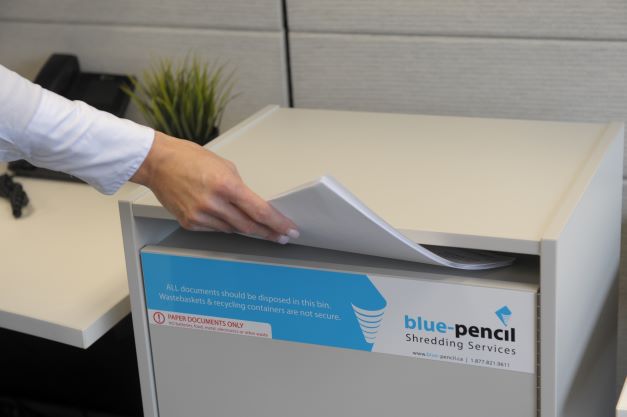
- Conduct a records and privacy audit – Identify what information you collect and how long you keep it.
- Develop a retention and destruction policy – Align with federal and Ontario privacy laws.
- Partner with a NAID AAA Certified shredding provider – This ensures secure, traceable, and standards-compliant destruction.
- Train employees – Reinforce secure handling and disposal practices across your organization.
- Maintain Certificates of Destruction – Proof that records were destroyed properly and on time.
How Blue-Pencil Helps You Stay Compliant
Shredding and data destruction services help organizations across Ontario meet the highest standards of privacy compliance.
- NAID AAA Certified & Privacy+ Certified for information security
- Secure chain of custody from pickup to destruction
- Certificates of Destruction for every job
- Flexible options including:
- Regular shredding services for offices and institutions
- One-time purge services for file cleanouts
- Hard drive & media destruction
- IT Asset Disposition (ITAD) for secure electronics recycling
Our team ensures your organization’s information lifecycle — from creation to destruction — remains secure, compliant, and efficient.
Stay compliant and protect your business in 2026.
Learn how Blue-Pencil’s certified destruction services keep your data secure — and your organization audit-ready.
Sources & Additional Resources
- Office of the Privacy Commissioner of Canada – PIPEDA Guidelines
- Information and Privacy Commissioner of Ontario – PHIPA Overview
- Canada Revenue Agency – Retention of Records
This article is provided for general informational purposes only and does not constitute legal advice. Organizations should consult legal or privacy professionals to ensure compliance with applicable laws.